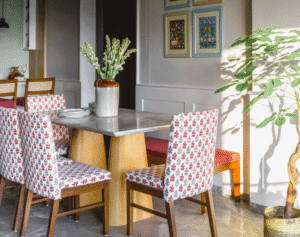
The living room in a 3 BHK apartment carries more weight than any other space in the home. It is where guests form their first impression, where children play after school, where families unwind after long days, and where celebration happens.
Yet it is also one of the most commonly misdesigned spaces in Indian homes. Too much furniture. Lighting that is either too harsh or completely absent. A television that dominates the entire wall. Colour choices made in isolation from the rest of the home.
At Behomly, we have designed and observed hundreds of 3 BHK living rooms. Here are ten ideas drawn directly from that experience, each one practical, tested, and designed to generate results.
1. Define Your Living Room’s Primary Function First
Before choosing colours, furniture, or lighting, define what your living room primarily does. In Indian homes, a living room often serves simultaneously as an entertainment space, a family gathering zone, a children’s play area, and a guest reception area.
The mistake is trying to optimise for all of these equally. Instead, rank them. Design for your top function, and ensure the secondary functions are accommodated without interference.
A family with young children should prioritise open floor space, durable fabrics, and furniture that can be moved. A couple who entertains frequently should prioritise seating arrangements that allow conversation, a strong bar unit, and lighting that can shift between ambient and intimate.
2. Let the Sofa Placement Drive the Layout
Most living rooms are designed around the television. The sofa faces the TV, and everything else is arranged to support that relationship. This creates a passive, cinema-style layout that limits conversation and flexibility.
A better approach is to let the sofa anchor the layout. Place it against the most solid wall, away from traffic paths. Then orient it toward a focal point, which may or may not be the television.
In a 3 BHK living room of 14 ft x 18 ft or larger, you can create a conversational seating cluster, a primary sofa flanked by two accent chairs, that does not face the TV at all. The TV can sit at an angle, visible but not dominant.
3. Use Layered Lighting, Not Just One Ceiling Light
Single-point ceiling lighting is one of the most persistent design failures in Indian interiors. A single tube light or chandelier creates flat, harsh illumination with no depth or warmth.
A 3 BHK living room should have at minimum three light layers:
- Ambient: Recessed LED ceiling lights on a dimmer circuit.
- Task: A reading lamp or pendant over the seating area.
- Accent: LED strips behind the TV unit or inside the bookshelf, wall sconces flanking a statement piece.
Behomly Insight: Switching from a single overhead fixture to a layered lighting system is one of the highest return-on-investment changes you can make to a living room. It changes the emotional atmosphere of the space completely.
4. Design the Feature Wall with Restraint
Every 3 BHK living room benefits from one strong feature wall. The challenge is restraint, the instinct is to add texture, wallpaper, a gallery arrangement, concealed lighting, AND a floating shelf all to the same wall.
Choose one technique and execute it with confidence:
- Fluted or reeded panelling in MDF or PU: Clean, contemporary, and adds architectural depth without visual noise.
- Venetian plaster or limewash: Warm, tactile, and distinctly elegant when done well.
- A curated gallery wall: Works in homes with an eclectic or maximalist sensibility. Requires careful curation, not every family photograph belongs here.
- A single large canvas or artwork: The most underused option. One strong piece on a clean wall says more than ten smaller ones.
5. Proportion the Furniture Correctly
The single most common furniture mistake in 3 BHK living rooms is over-scaling. A sectional sofa that seats eight in a 12 ft x 16 ft room leaves no space for movement, visual breathing room, or a second seating element.
For most 3 BHK living rooms, a three-seater sofa with two accent chairs creates more flexibility and a more refined aesthetic than a large sectional. Add a narrow console behind the sofa to create a visual divider from the dining space without using a wall.
6. Integrate Storage Without Sacrificing Style
A 3 BHK living room accumulates storage needs from the entire household, board games, books, extra cushions, chargers, remotes, the children’s school bags when they walk in. Without planned storage, these items create visual clutter within weeks of moving in.
- Floor-to-ceiling wall units with a mix of open shelves and closed cabinets handle both display and concealed storage.
- Ottomans with internal storage replace coffee tables and provide flexible seating.
- Console tables with drawers or baskets beneath create discreet storage near the entrance.
7. Choose a Colour Palette That Connects to the Rest of the Home
The living room colour palette should not exist in isolation. It should be the first expression of a colour language that continues into the dining space, hallway, and kitchen.
A reliable approach for 3 BHK homes: start with a warm neutral as your base (think warm white, light greige, or soft putty), introduce one accent colour in soft furnishings (a dusty terracotta, a deep forest green, or a muted cobalt), and let natural materials, wood, cane, linen, stone, add warmth without competing.
8. Treat the Ceiling as a Design Surface
Most living room ceilings in India are either completely flat (missed opportunity) or over-treated with ornate false ceilings that dominate the space (overcorrection).
In a 3 BHK living room with 9 ft or higher ceilings, consider:
- A simple perimeter cove ceiling with indirect warm LED lighting.
- A floating tray ceiling centred over the seating area.
- Exposed beams (real or decorative) running the length of the room for a contemporary rustic look.
Behomly Insight: A well-designed ceiling adds 40 to 50 percent more visual value to a room than the same investment in wall treatment. The ceiling is the fifth wall, design it accordingly.
9. Control the Visual Weight of the TV Wall
Television walls in Indian homes are often over-engineered. Backlit LED panels behind the TV. A large media unit below. Shelves on either side. Decorative panels. All competing for attention.
A more refined approach: choose one element to anchor the TV wall. A fluted panel background with the TV mounted flush. Or a floating media unit in a warm wood finish with the TV above it on a clean wall. Let the television itself become the focal point, supported by clean architecture rather than competing with decoration.
10. Introduce Natural Materials for Warmth
Indian interiors benefit enormously from natural materials, not as a trend, but as a cultural and climatic choice. Cane, rattan, solid wood, natural stone, and hand-loomed textiles all add warmth, texture, and tactility that no paint or wallpaper can replicate.
In a 3 BHK living room:
- A solid wood coffee table with visible grain grounds the space.
- Cane-backed accent chairs add texture without weight.
- A hand-knotted or flatweave rug defines the seating zone and adds acoustic softness.
- Terracotta or stone accessories on the shelving add earthiness to a neutral palette.
| ✦ Want a 3 BHK living room that you will love for years? Behomly designs spaces that feel considered, not assembled. ✦Schedule a free consultation → behomly.com |
Frequently Asked Questions
What is the ideal size for a 3 BHK living room?
Most 3 BHK apartments in India have living rooms between 180 and 280 sq. ft. The layout quality matters more than raw square footage. A 200 sq. ft. living room with thoughtful planning will outperform a 300 sq. ft. room with poor furniture placement.
What interior design style works best for a 3 BHK living room in India?
Contemporary Indian, a blend of modern forms with warm materials and cultural accents — suits most Indian households. It is adaptable, warm, and ages well.
How much does a 3 BHK living room design cost in India?
Budget range: ₹2–4 lakhs for essential design and furnishing. Mid-range: ₹5–9 lakhs with quality furniture, lighting design, and wall treatment. Premium: ₹12 lakhs and above with custom joinery and imported materials.